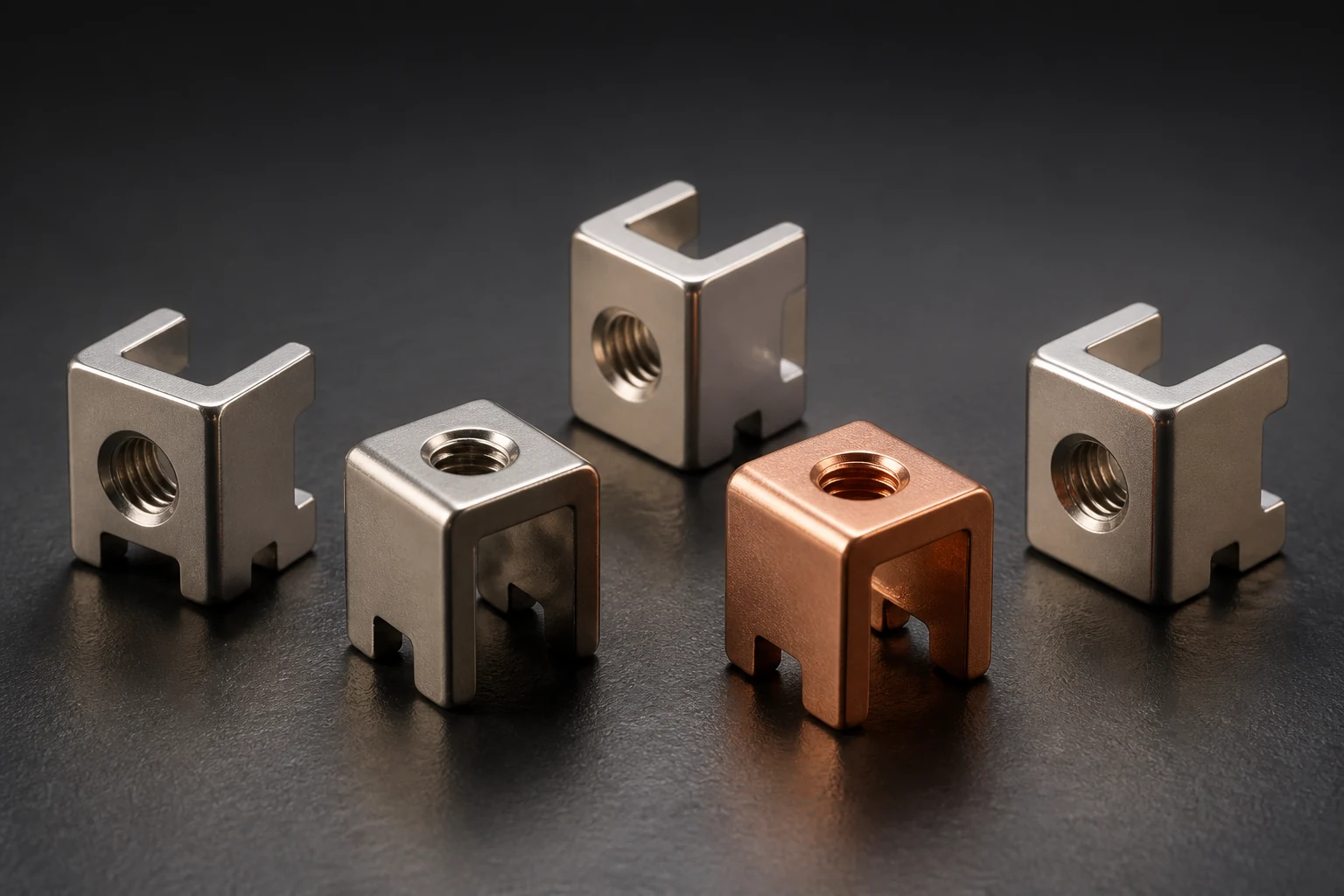
PCB terminal materials must meet current-carrying, stamping, joining and production-consistency needs together. Copper Development Association alloy data lists a minimum conductivity of 100% IACS for annealed C11000, while its C19400 page lists about 65% IACS and includes electrical-connector applications. Compare grades with temper and geometry in view.
Separate rigid conductors from spring terminals
A busbar or thick copper connector prioritizes section, temperature rise, joint interface and manufacturing route. A spring terminal also needs insertion force, contact force, elastic deflection and cycle stability. Equal nominal thickness does not make these geometries perform the same task.
Copper-alloy data presents conductivity, strength, corrosion and formability together. The alloy designation is only a starting point because annealed and work-hardened tempers change the mechanical properties available in the part.
Make the conductivity-strength trade-off explicit
C11000 is a candidate when high conductivity is the main material priority. CDA identifies C19400 as a copper-iron alloy and lists connector use, formability and moderate strength. Public database values can screen candidates; they do not replace material certification for a purchased lot.
Increasing terminal thickness can add conductive section and also change forming force, placement height and solder-pad load. A higher-strength alloy may suit an elastic or mechanical function. Loss, temperature rise and joining compatibility still require design validation.
Specify grade, temper and part conditions in the RFQ
State the UNS or agreed material standard, thickness, temper, rolling-direction requirement, finish and critical forming dimensions. The purchase specification should also define material certificates, sampling for conductivity or mechanical properties and change-notice requirements.
Test parts should use the target thickness, rolling direction and stamping process. When the final component is bent, riveted or reflow soldered, include those operations in evaluation and record the actual current path, temperature rise or joint strength.
- Identify the alloy and annealed or work-hardened temper
- State current, allowed temperature rise, bend radius and assembly method
- Validate electrical and mechanical performance in the final geometry
Use data sheets with lot evidence and design validation
CDA property tables and typical uses help narrow candidate alloys. Acceptance should cite the contracted material standard and actual supply certificate. Current capability depends on final section, cooling, contact design and installation environment.
Apply this guide to a project
Use product pages to identify the hardware family and the calculator for early estimates only. Acceptance depends on drawings, operating conditions and project tests.