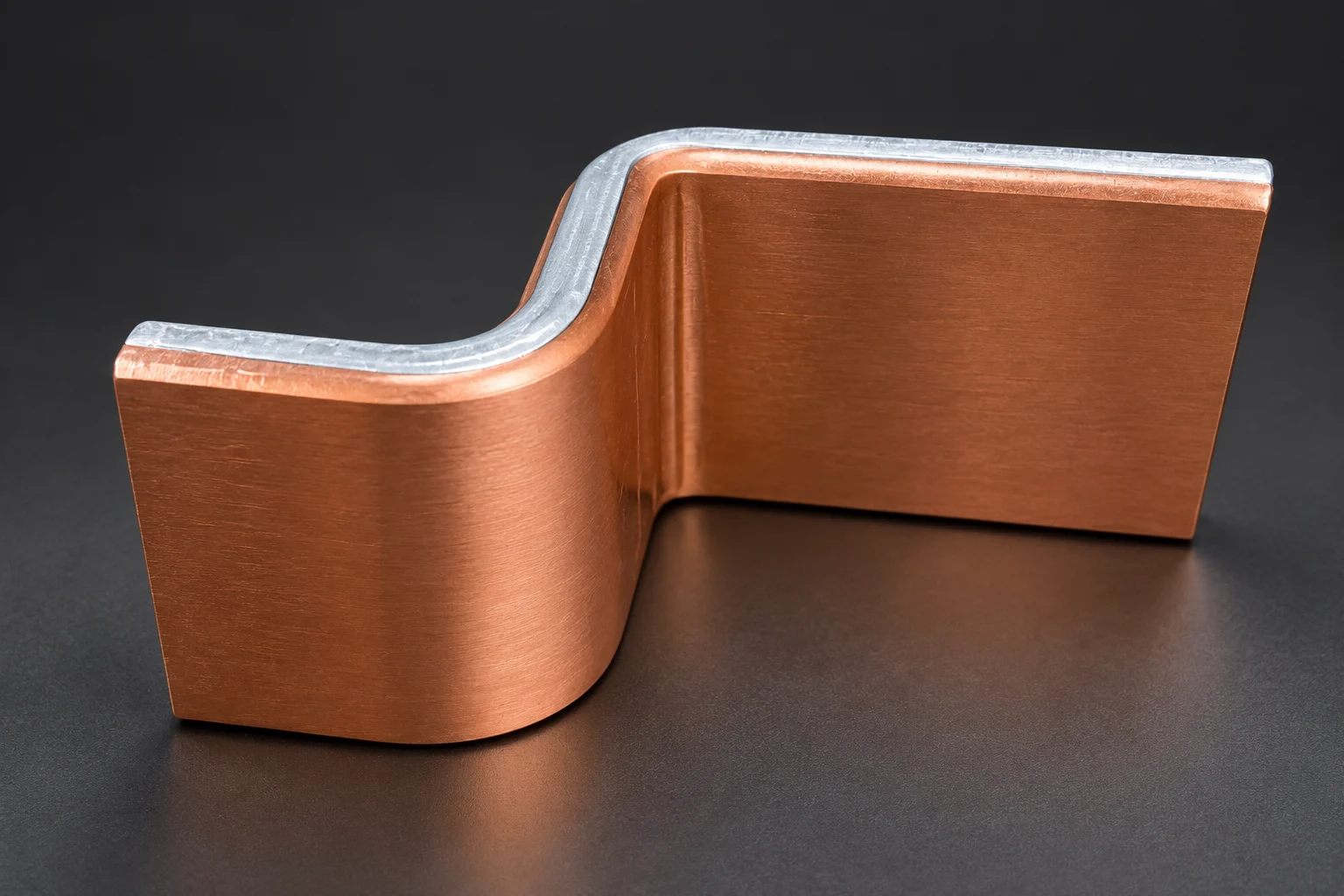
Penetrant inspection addresses discontinuities connected to accessible Cu-Al busbar surfaces. Internal bond defects with no surface opening are outside its direct coverage. Map the target regions, confirm inspectability and agree indication acceptance separately. No indications does not prove the whole copper-aluminum interface defect-free.
Map the surfaces requiring inspection
ASTM E165/E165M addresses surface-open discontinuities in nonporous materials and does not supply indication acceptance criteria. We recommend mapping bend exteriors, machined edges or transition regions, distinguishing bare surfaces from plated or insulated areas.
Retain covered and inaccessible regions as report boundaries. Have the inspector establish inspection stage and method without unauthorized grinding of copper or insulation removal. Internal-bond questions require separately qualified interface methods; do not expand a surface examination into volumetric coverage.
Confirm cleaning and consumable compatibility
Magnaflux explains that grease, treatment residues and previous inspection residues can inhibit penetration. We recommend documenting cleaning, drying, post-cleaning and consumable identity, batch and condition. Have the inspector confirm dwell conditions for the actual material and temperature rather than assigning one generic duration.
Review cleaner and penetrant compatibility with insulation and seals, using representative samples where needed. Record indications separately from background residues. Do not omit delivery-surface changes from unapproved cleaning or mechanical preparation.
Record indications and assess agreed criteria
Retain region maps, conditions, indication locations and scaled photographs for classification against agreed criteria. Define relevant type, size, position and direction. Without criteria, report observations for the responsible party instead of treating a procedure name as automatic acceptance.
Remove residues using an approved process and confirm contact and insulation condition. Retain before/after rework records and required reinspection. Indications do not directly establish defect depth, interface strength or busbar life, and do not replace resistance or temperature-rise checks.
- Limit coverage to inspectable surfaces
- Review cleaning and compatibility
- Agree procedure and acceptance separately
Frequently asked questions
Do no indications prove an intact internal interface? Closed internal issues still require other applicable assessment methods.
Must every indication lead to scrap? Apply agreed criteria and responsible-party review, not a decision from photographs alone.
RFQ and inspection inputs
Provide structure, manufacturing history, plating and insulation zones, target surfaces and inspection stage. Agree compatibility, indication criteria, post-cleaning and reinspection ownership. Use personnel with an applicable method and safety arrangements; do not promise a universal detectable defect size.
Apply this guide to a project
Use product pages to identify the hardware family and the calculator for early estimates only. Acceptance depends on drawings, operating conditions and project tests.