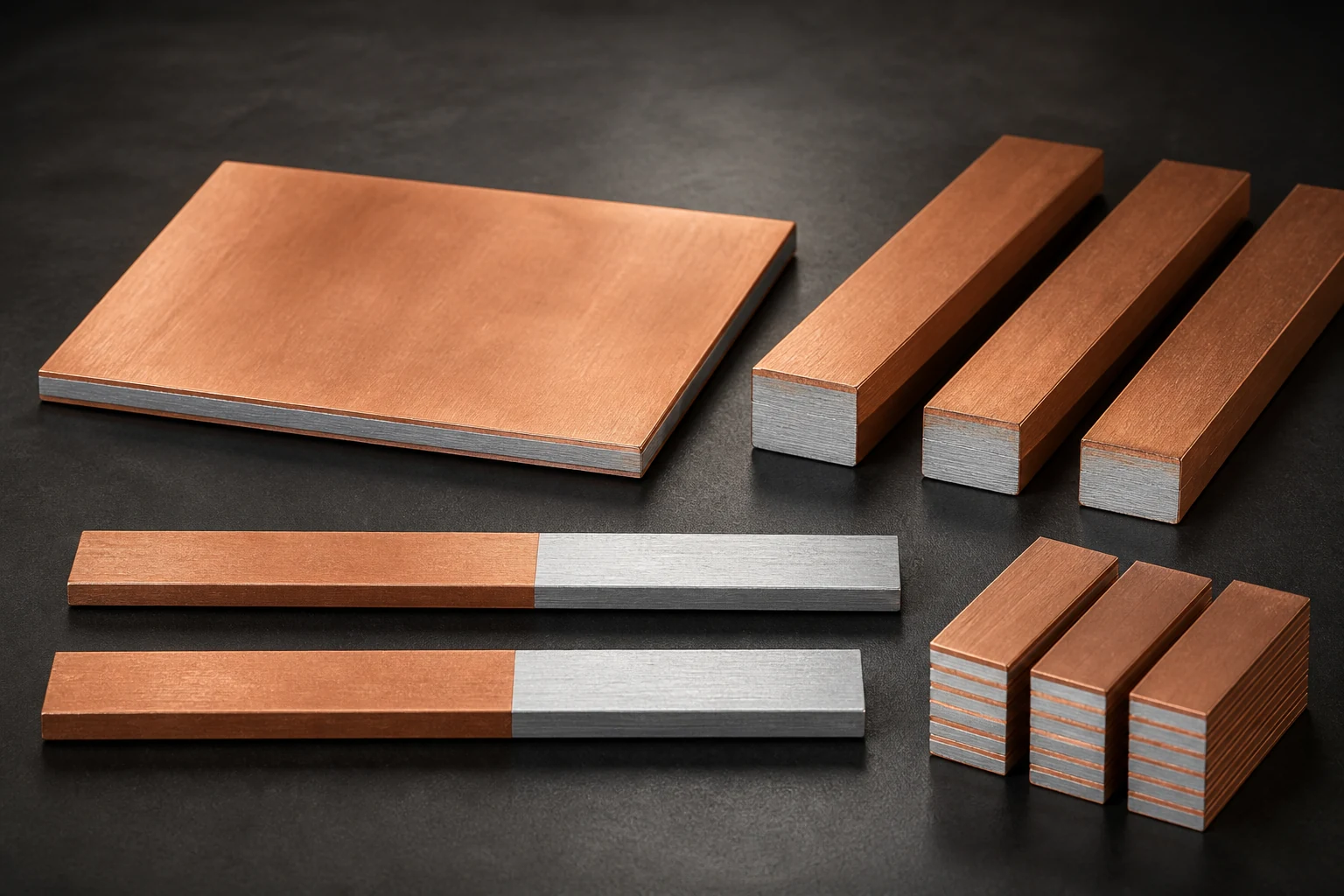
Use eddy-current conductivity readings for batch comparisons only after validating the method for the actual Cu-Al structure. A reading does not directly establish whole-bar DC resistance or current capacity. Confirm calibration materials, frequency and layer compatibility before setting acceptance rules.
Establish what material the instrument model represents
ASTM E1004 covers eddy-current conductivity measurement of nonmagnetic materials, commonly expressed in %IACS or S/m. Its scope includes flat or slightly curved surfaces and thin nonconductive coverings. Those conditions do not establish homogeneous-material interpretation for a conductive copper layer over aluminum.
We recommend providing cladding distribution, thickness, core material and measuring face to the instrument or inspection owner. Validate the reading model with representative layered samples. Capability through an insulating covering does not establish equivalent capability through another conductive metal.
Freeze temperature, frequency and probe position
Fischer identifies temperature, thickness and probe position as important influences, with frequency and material-dependent minimum thickness needing compatibility. Conductivity conventionally refers to 20°C. Confirm temperature conversion and calibration conditions before comparing batches.
Mark locations on drawings and retain instrument, probe, frequency, references and temperature. Validate bends, hole edges and narrow regions separately. Repeatable readings at one location demonstrate repeatability under those conditions, not that the material model is correct.
Build comparison rules with representative samples
We recommend retaining samples across relevant thicknesses and layer structures, correlating readings with approved resistance, section or material checks. Quality and engineering owners should agree sampling, limits and investigation paths. Until correspondence is established, use readings as investigation inputs rather than independent release criteria.
Retain original abnormal readings and review temperature, surfaces and locations before assigning a batch cause. Forming, covering or material-state changes require method review. Determine current capacity under actual installation and temperature-rise conditions; do not calculate it from a single %IACS value.
- Validate the layered structure against the reading model
- Freeze calibration, temperature, frequency and locations
- Establish sample comparisons and abnormal-result review
Frequently asked questions
Does a copper-like reading permit pure-copper selection? No. Review whole-part resistance, temperature rise and connections separately.
Does instrument calibration qualify every composite? Validate each relevant layer structure, thickness and geometry.
RFQ inputs for conductivity inspection
Provide sections, cladding locations and thickness, material state, instruments and reference samples. Separate screening, material identification and electrical acceptance. Agree units, locations, sampling, investigation and supply responsibilities.
Apply this guide to a project
Use product pages to identify the hardware family and the calculator for early estimates only. Acceptance depends on drawings, operating conditions and project tests.