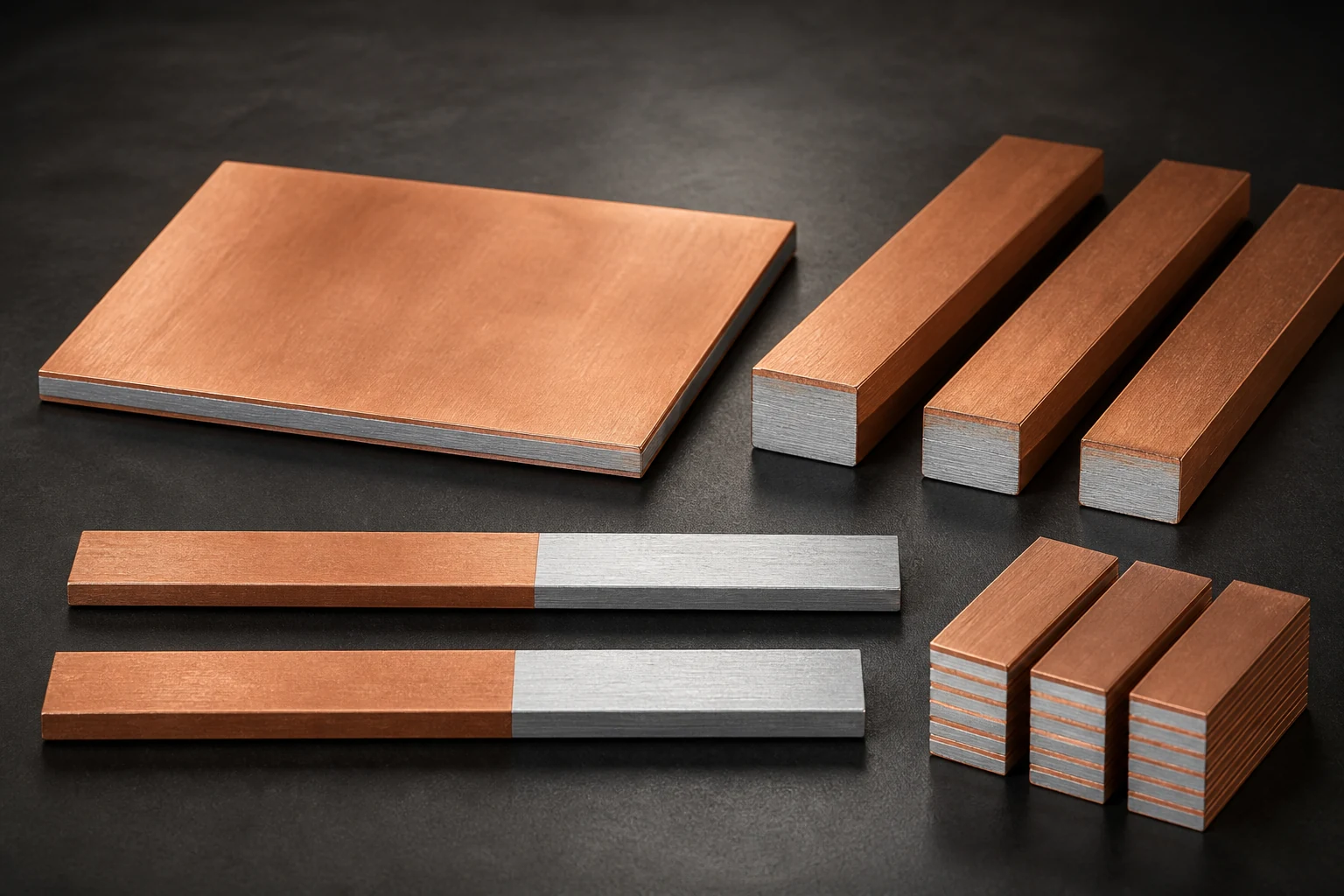
Select disc springs for a Cu-Al busbar joint from the required clamp force and installed movement range. Matching bore diameters does not establish interchangeability, and adding discs does not automatically improve reliability. Validate assembly and electrical performance on the actual joint.
Review clamp force and available travel together
SCHNORR distinguishes series stacking, which adds deflections at the same force, from parallel stacking, which adds forces at the same deflection. Combined arrangements change the overall characteristic. Choose the arrangement for the required behavior.
We recommend supplying the overlap, fasteners and supports with the permitted compression range. Give the spring supplier installed heights, assembly tolerances and expected movement, then review force throughout the range. The connection owner must establish loads, travel and margins; bolt diameter alone cannot determine them.
Define stacking direction and supports in section
SCHNORR also identifies guidance as necessary to prevent lateral movement. We recommend drawing every disc orientation, abutment, guide and clearance, with part identities and quantities. Total height alone cannot uniquely specify an arrangement.
Review bearing area, holes and insulation space separately. Check the actual supports and guides without turning one manufacturer's material, hardness or temperature guidance into universal joint requirements. Reassess assembly after spring, fastener finish or lubrication changes.
Retain assembly measurements before joint validation
We recommend recording batches, disc orientation, tightening and installed height on representative joints. Use a validated force-verification method and explain whether its equipment changes the joint. Torque, height and force have different uses; unvalidated height readings are not measured preload.
Compare initial and post-environmental or mechanical-test resistance, temperature rise and condition against project requirements. Record the as-found state before retightening. Disc springs do not replace separate contact-face, locking or short-circuit reviews. Never dismantle energized joints to measure mechanical loading.
- Define force throughout the working travel
- Draw orientations, supports and guidance
- Retain as-found states and validate electrical behavior
Frequently asked questions
Do more discs increase force and travel together? Arrangement determines the change; use the corresponding characteristic.
Can a locking washer replace a disc spring with the same bore? Review function, load-deflection behavior and installation rather than diameter alone.
RFQ inputs for joint sections and loads
Provide materials, overlap drawings, fastener identities, spring arrangement and space. State required force, permitted movement, environment and validation separately. Agree spring, busbar and complete-connection supply and acceptance responsibilities. Resolve missing load or travel inputs before sample review.
Apply this guide to a project
Use product pages to identify the hardware family and the calculator for early estimates only. Acceptance depends on drawings, operating conditions and project tests.