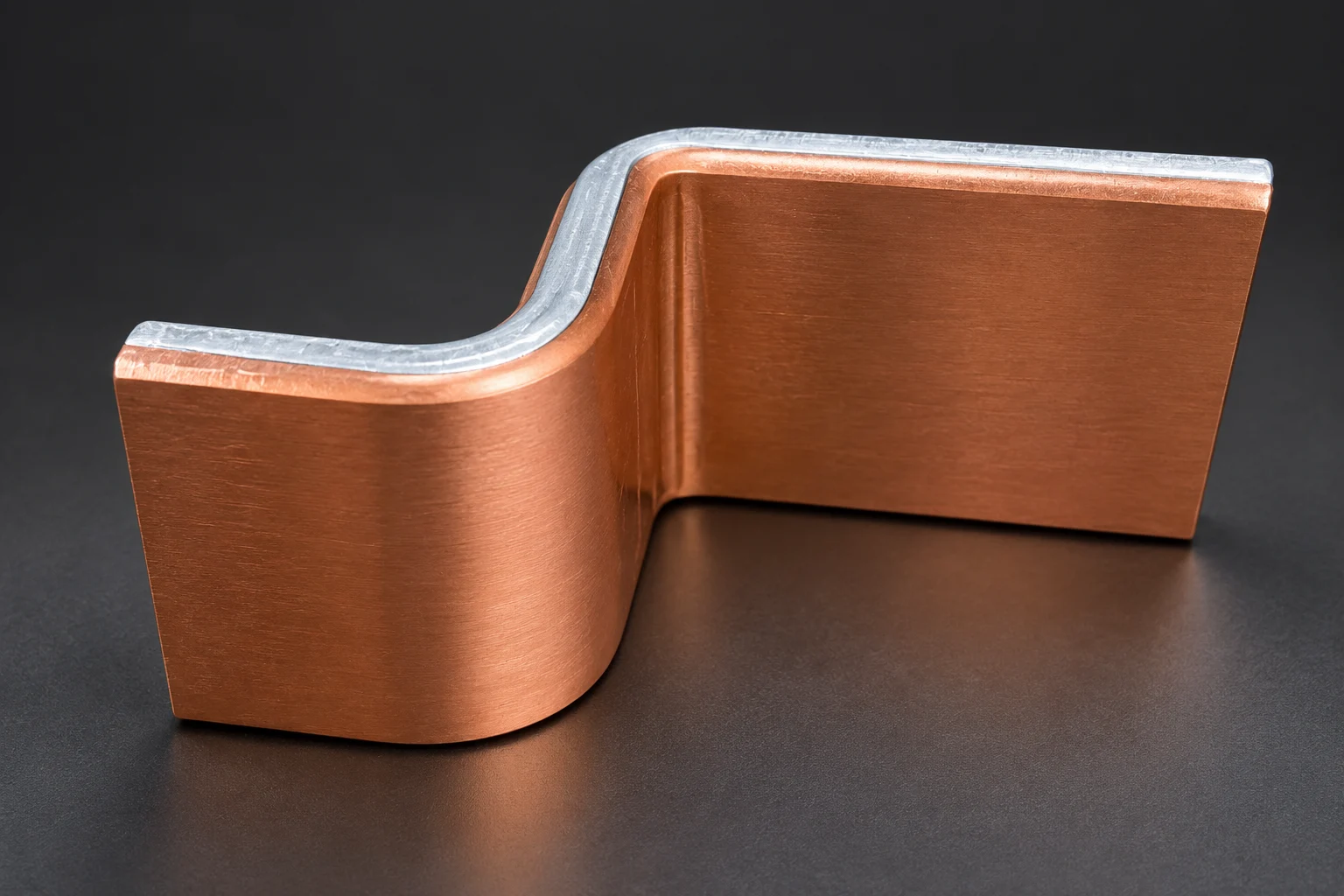
A UPS Cu-Al busbar thermal report should identify current entry and exit, heat removal paths and joint representation. A temperature plot becomes useful only with these inputs. Request the model revision, boundary table and matching measurements alongside the predicted maximum temperature.
Identify conductors and joint representation
COMSOL's busbar tutorial couples current and energy conservation to calculate Joule heating with explicit materials and boundaries. Its electrolysis assembly is a specific example. Do not import its currents, temperatures or design targets into a UPS composite conductor.
We recommend a current path and layer drawing identifying copper, aluminum, finishes and insulation coverage. If a joint is simplified into a continuous solid, document the omitted contact effects and evidence supporting that simplification. Keep bulk resistivity and joint resistance separate.
Match cooling assumptions to the cabinet
COMSOL distinguishes natural convection, forced flow and enclosed spaces. Empirical correlations require compatible geometry and characteristic dimensions. One coefficient applied to every surface does not automatically represent a cabinet airflow path.
Identify air temperature, convection, radiation and support conduction by surface, with fan state, nearby heat sources and obstructions. Explain fixed end temperatures. Compare conductor options under matched boundaries, or report the separate effects of changed airflow, end cooling and insulation coverage.
Make the result independently reviewable
Retain mesh and solver settings. We recommend sensitivity checks near holes, contacts and layers, comparing maximum temperature, specified measurement locations and total loss. A smoother color plot after mesh refinement does not establish convergence. List unresolved local geometry as a limitation.
Compare temperature and voltage drop on specimens with matched current, ambient and mounting. Record discrepancies and uncertain inputs. If parameters were adjusted to fit one test, check another condition excluded from that adjustment. A steady state result does not directly cover short overloads; DC loss modeling also needs a separate applicability review for ripple.
Frequently asked questions
Does a low predicted temperature approve a rated current? Confirm inputs, installation boundaries and assembly evidence against the equipment requirements.
Can a Cu-Al conductor use a pure copper model? Justify the material representation for the actual layers and purpose rather than assuming equivalence.
UPS Cu-Al busbar RFQ inputs
Provide assembly drawings, material layers, current conditions, airflow, ambient, contacts and supports. Define whether the scope is part supply, model review or equipment validation. Specify model files, input tables, measurement comparisons and report deliverables separately.
Apply this guide to a project
Use product pages to identify the hardware family and the calculator for early estimates only. Acceptance depends on drawings, operating conditions and project tests.