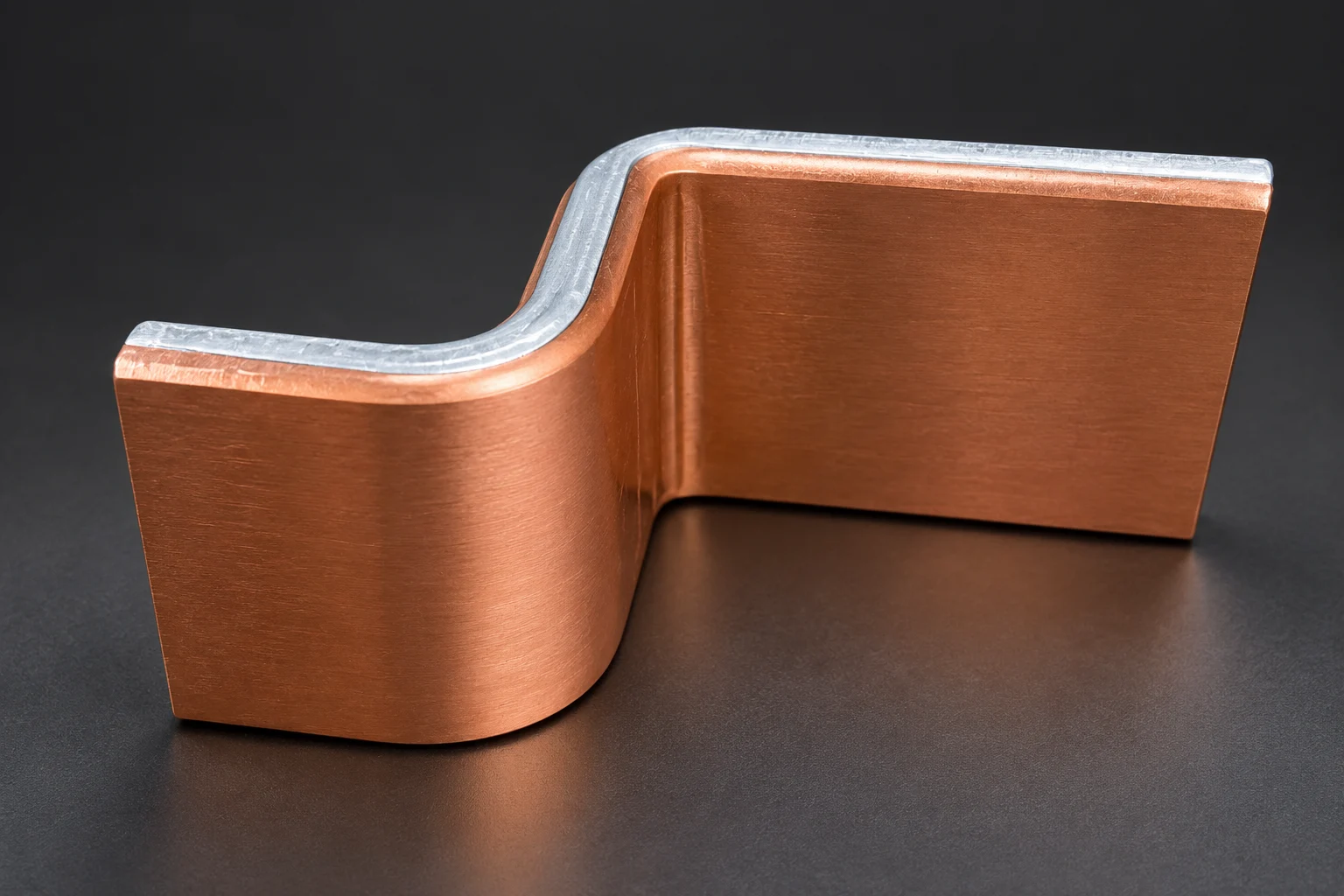
Freeze overlap layers, beam direction and clamping before developing a PCS Cu-Al laser weld window. Copper on top, aluminum on top and joining an existing composite conductor require distinct descriptions. Thickness and a seam photograph alone cannot define comparable sampling requirements.
Identify the layer receiving the beam
TRUMPF distinguishes different laser metal joining processes, including the separate use of a laser for soldering. State whether the task is parent metal fusion or laser soldering. Kaufmann and colleagues compare Cu-Al overlap welding paths on specific research specimens; their settings are not a PCS joint recipe.
We recommend a section drawing with every material, thickness, finish, surface condition and incident side. For an existing composite, locate the original interface relative to the new weld and agree its inspection coverage. Use separate specimens for joining independent metals and joining composite ends rather than assuming equivalence.
Make gap and clamping repeatable
The study includes clamping and joining gap control and compares stitched and oscillating strategies. Procurement review can request the actual path and fixture conditions instead of only laser power or wavelength.
Show allowed gap, clamp locations, support, optical access and neighboring insulation keepouts. Record material lots and preparation, with the worst intended fit conditions. A hand-clamped ideal coupon cannot automatically cover formed-part variation. Include shielding arrangements and tooling condition in trial records.
Collect complementary evidence on the same joint
Agree sections at seam starts, ends, turns and representative locations to examine fusion, pores, cracks and the adjacent composite interface. Phase identification needs a suitable method, not section color alone. Mechanical results should include loading direction and failure location alongside peak force.
Check resistance and temperature rise under agreed cooled, mounted and loaded conditions, then select environmental or endurance work for the equipment. Appearance cannot establish a current rating. Reassess layer, finish, fixture or path changes without turning a wavelength, width or research optimum into a universal requirement.
Frequently asked questions
Does a machine's ability to weld copper and aluminum qualify this overlap? Confirm the actual dissimilar stack, gaps and fixtures on samples.
Is deeper penetration always better? Review fusion extent, mixing and surrounding material effects against joint requirements.
Storage PCS Cu-Al transition RFQ inputs
Provide overlap sections, incident direction, materials, finishes, gap and fixture drawings, plus subsequent insulation and assembly requirements. Quote parts, fixtures, sections and mechanical/electrical validation separately with individual records and report deliverables.
Apply this guide to a project
Use product pages to identify the hardware family and the calculator for early estimates only. Acceptance depends on drawings, operating conditions and project tests.