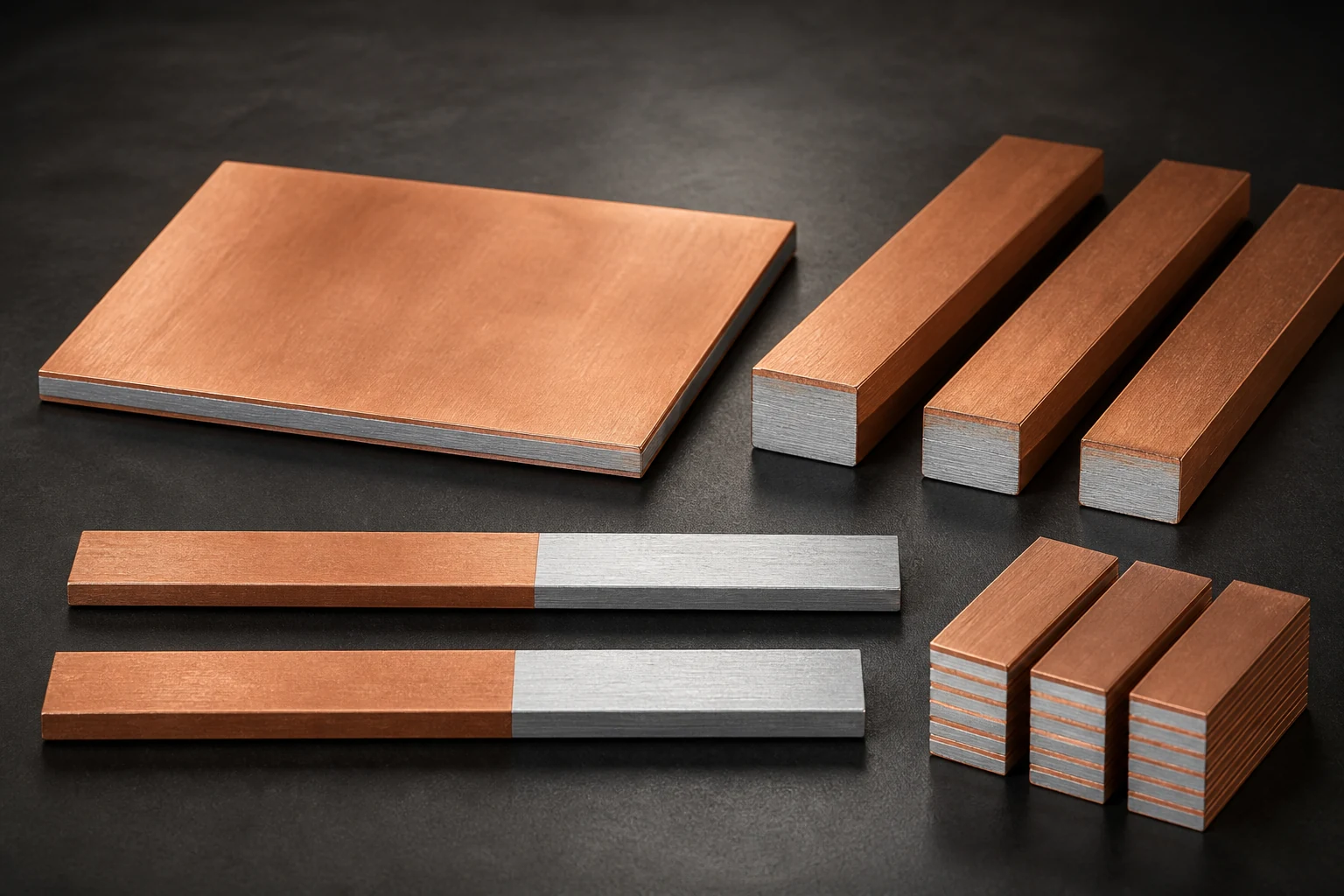
Compare Cu-Al resistance per metre using consistent gauge length, section, temperature and sense-point positions, excluding external joints from the conductor gauge. Calculate R = V / I, then R / L. Conductivity percentages alone do not establish assembled voltage drop or rated current.
Decide whether the subject is stock or an assembly
For material comparison, use a uniform straight specimen with voltage sense points defining length L and current fixtures outside that gauge. Report an assembly containing joints, holes or bends separately with its end-to-end resistance and measurement locations.
ASTM B193-25 covers metallic conductor resistivity measurement, including dimensions, weight, density, resistance and reference-temperature correction. Its method scope is not an ampacity certification for a composite busbar.
Report length, section and units together
At a common temperature, R / L compares resistance per unit length. For a uniform specimen, ρ = R × A / L gives effective volume resistivity defined on the total section. With R in Ω, A in m² and L in m, ρ is in Ω·m. Do not insert the largest section of a perforated or varying-section part into this expression.
Identify total section and composite construction. Retain separate specimen conditions when geometry or copper fraction differs. A contract can specify material resistivity and finished-part resistance as separate acceptance requirements.
Control self-heating and correction
Use separate current and voltage-sense paths for low-resistance measurement, controlling thermal EMF, sense contact and instrument drift. Excess current or duration changes specimen temperature. Record temperature stability and adjust current or duration using the approved procedure.
Retain original resistance, measured temperature, reference temperature and correction method. Use confirmed temperature-coefficient data for the composite; a copper surface does not justify a pure-copper coefficient. ASTM B193 notes that assumed-density errors can affect weight resistivity.
- Record specimen ID, total section, gauge length and surface condition
- Retain current, voltage, temperature, repeat readings and calibration evidence
- Compare stock at the same temperature basis and test drop and rise on the actual assembly separately
Frequently asked questions
Does lower resistance per metre permit direct copper substitution? Terminal current distribution, cooling, insulation, support and fault duty still require review.
Can resistance values from different-length finished parts be compared directly? First check joints and section changes. Length normalization is meaningful only for comparable uniform gauges.
State the comparison basis in the RFQ
Provide stock sections, finished current path, target resistance or drop, temperature basis, sense positions, fixtures, sampling and acceptance limits. If the target comes from an existing copper part, include measurements under matching conditions and its assembly drawing.
Apply this guide to a project
Use product pages to identify the hardware family and the calculator for early estimates only. Acceptance depends on drawings, operating conditions and project tests.