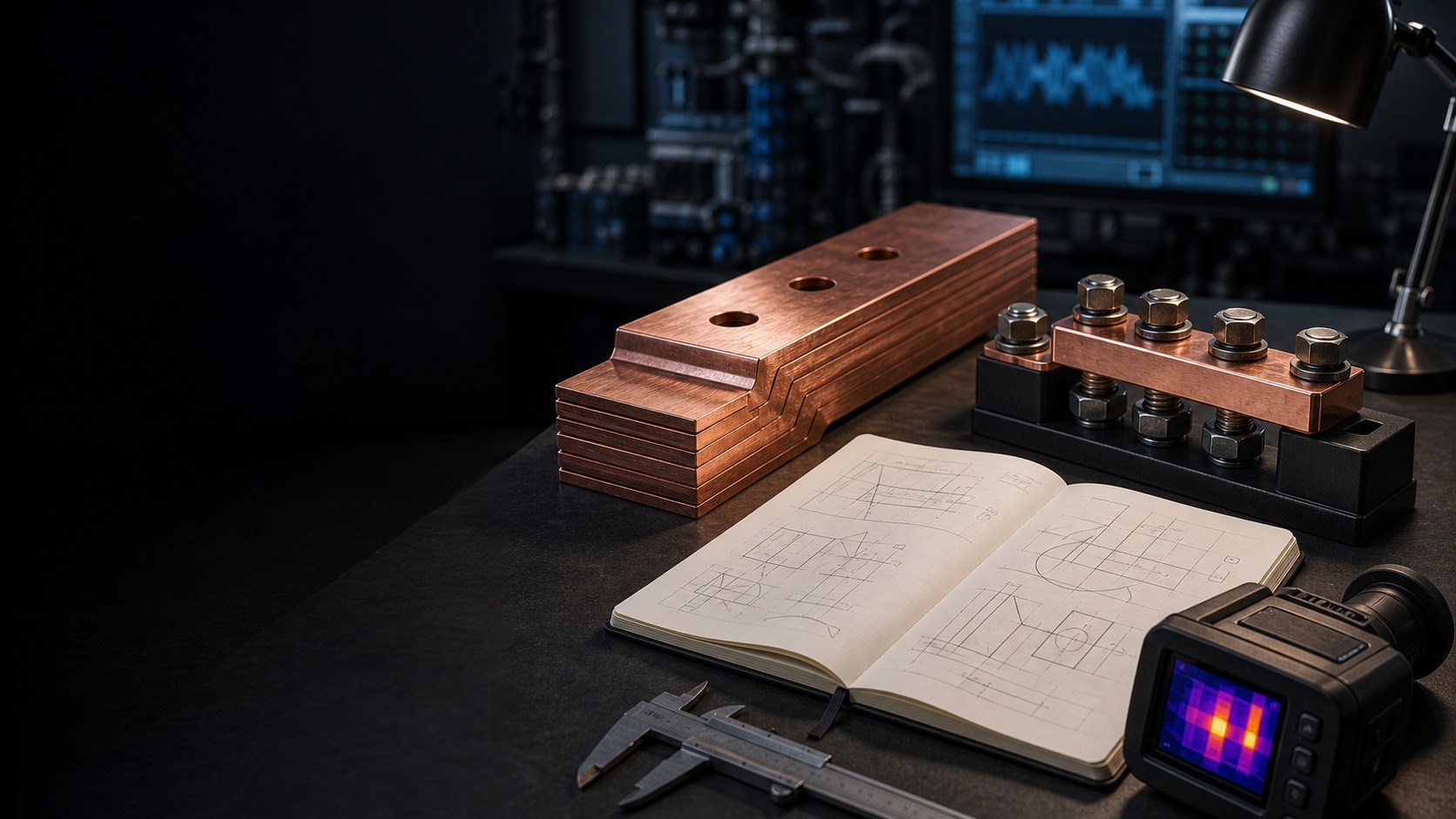
Large differences between busbar quotations often begin with an incomplete drawing. Each supplier fills in the missing material condition, plating boundary, tolerance or inspection method differently. The resulting prices are not directly comparable.
Material and temper
Specify copper grade, temper and governing material standard. Temper affects bending, springback and assembly. Composite material drawings should also define layer structure, orientation and end preparation.
- Material grade and temper
- Accepted raw-material standard
- Composite layer structure and tolerance
Dimensions, tolerances and datums
Identify total size, critical hole positions, bend heights and assembly datums. Avoid applying one unnecessarily tight general tolerance to every feature. Separate dimensions that control assembly and contact from ordinary dimensions.
- Critical and noncritical dimensions
- Hole diameter, pitch and edge distance
- Flatness, parallelism and burr direction
Bends and manufacturing features
Define inside radius, bend direction, angle tolerance and permitted marking. Multi-bend parts need a feasible process sequence and interference review. Distinguish punched, milled, threaded and welded features on the 2D drawing.
- Bend radius and direction
- Process restrictions
- Deburring, chamfer and edge requirements
Current and temperature rise
State continuous current, peak current, peak duration and allowable rise together with ambient temperature, orientation, adjacent spacing and cooling. Published copper busbar data show that spacing, number of bars, emissivity and permitted temperature rise all affect ampacity.
- Continuous and peak load
- Allowable rise and ambient temperature
- Installation, spacing, insulation and cooling
Interfaces and hardware
Define the contact zone, mating material, bolt size, washer arrangement and target torque. Note indentation limits, masking and plating boundaries. Terminal products also need conductor size, termination process and pull or voltage-drop requirements.
Finish and insulation
For tin, nickel, silver or bare copper, state finish, thickness, test method, coverage and keep-out areas. Insulation coatings, heat-shrink or dip coatings need thickness, temperature rating and window locations.
Environment and validation
Select thermal cycling, vibration, humidity, salt exposure and flammability requirements from the application. Define responsibilities for dimensions, material certificates, plating, DC resistance, temperature rise and environmental tests.
Volume, packaging and delivery
Provide current quantity, annual estimate, project stage, target timing and delivery region. Packaging should protect copper surfaces, prevent impact damage and support the intended handling direction.
- Order quantity and annual estimate
- Prototype approval and production release
- Packaging, labels and delivery region
Make quotation assumptions visible
Ask each supplier to list material, process route, finish, tooling, inspection, packaging, lead time and quotation validity. Drawing gaps should appear as written assumptions. Procurement can then see whether a price difference comes from material, process or risk allowance.
Apply this guide to a project
Use product pages to identify the hardware family and the calculator for early estimates only. Acceptance depends on drawings, operating conditions and project tests.