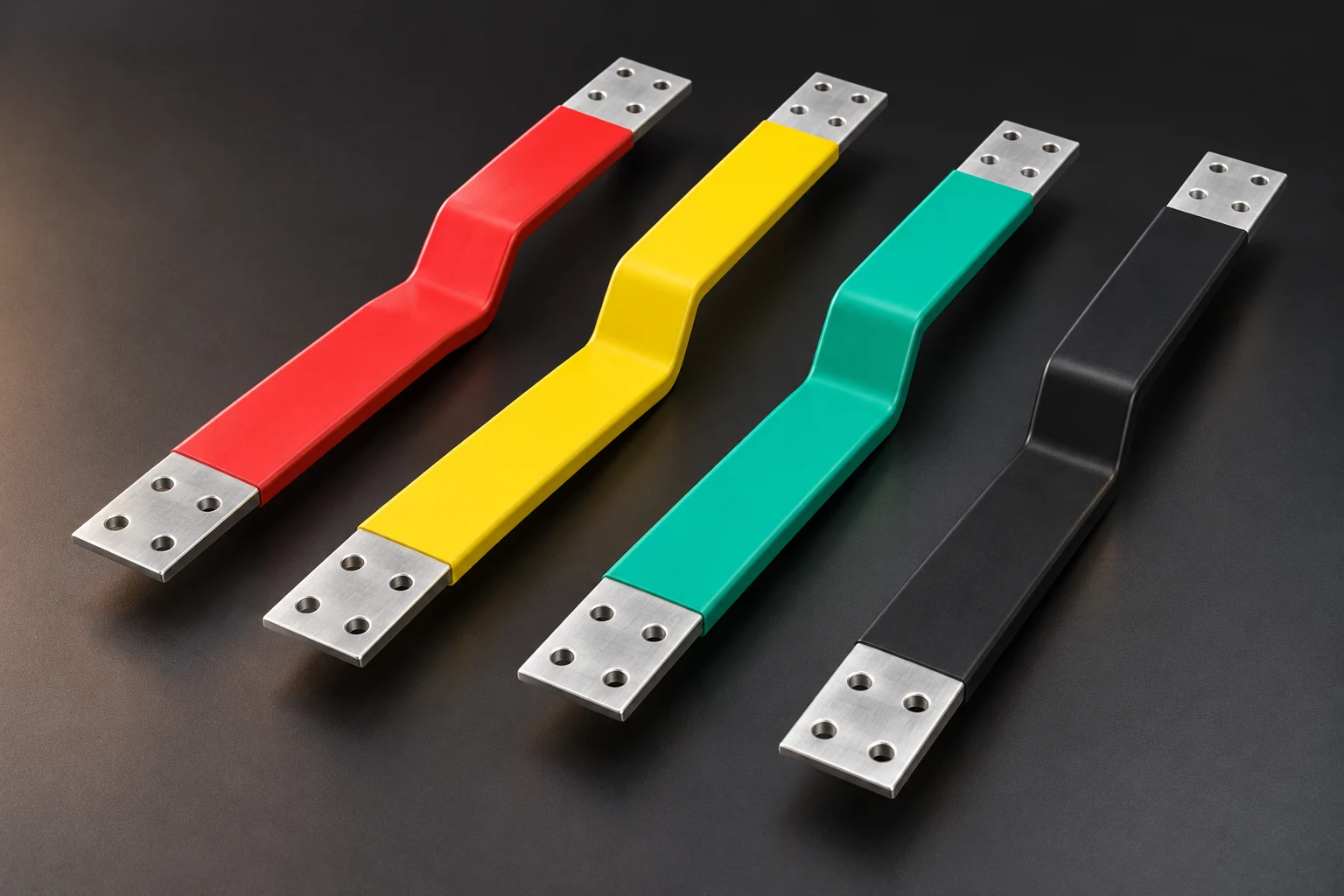
DSC can support an epoxy-cure review when formulation, sampling and reference states are defined. A hard surface or an oven reaching its setpoint does not alone establish complete-part cure. Thermal analysis does not replace dielectric, adhesion or coating-integrity checks.
Identify the coating and sample
ISO 11357-5, 2025 edition, addresses reaction temperatures, times, enthalpy and conversion using conventional DSC. Request the resin, curing system, fillers and sample condition. Different formulations cannot automatically share one reaction-enthalpy reference.
Explain whether the sample is powder, a co-processed witness or material from a finished part. Link its batch, mass and location to the busbar. Another batch or a thin coupon does not automatically represent every coating region on a heavy layered conductor.
Separate initial condition from post-curing during analysis
NETZSCH's epoxy example shows that a partially cured sample can react further during DSC heating, with glass transition and post-curing signals overlapping. Ask the analyst to explain the conventional or modulated method and interpretation rather than declaring complete cure from one peak temperature.
Where conversion is calculated, request the reference sample, enthalpy basis, mass normalization and calculation rule. Leave an unknown reference unresolved; do not borrow another resin's values to create an acceptance percentage.
Connect analysis to production records
Propose recording actual thermal histories at relevant busbar locations alongside oven settings and sample identity. Have the process owner assess witness-sample representativeness and define batch or change-triggered review. A setpoint screenshot is not finished-product evidence.
Accept cure state, adhesion, insulation thickness and electrical performance as separate items. Complete the drawing-based inspections even after thermal analysis passes. One formulation's cure window is not a universal recipe for all Cu-Al layer structures.
Frequently asked questions
Does a second heating prove full cure at shipment? Distinguish the initial state from the state modified by analytical heating.
Can every coating use one acceptance percentage? A matching formulation, calculation reference and functional qualification are required.
UPS coated-busbar RFQ inputs
Provide layer geometry, coating system and thickness requirements, with permitted thermal processing. Quote DSC analysis, thermal records and finished insulation acceptance separately. Review missing formulation references with the material and process owners.
Apply this guide to a project
Use product pages to identify the hardware family and the calculator for early estimates only. Acceptance depends on drawings, operating conditions and project tests.