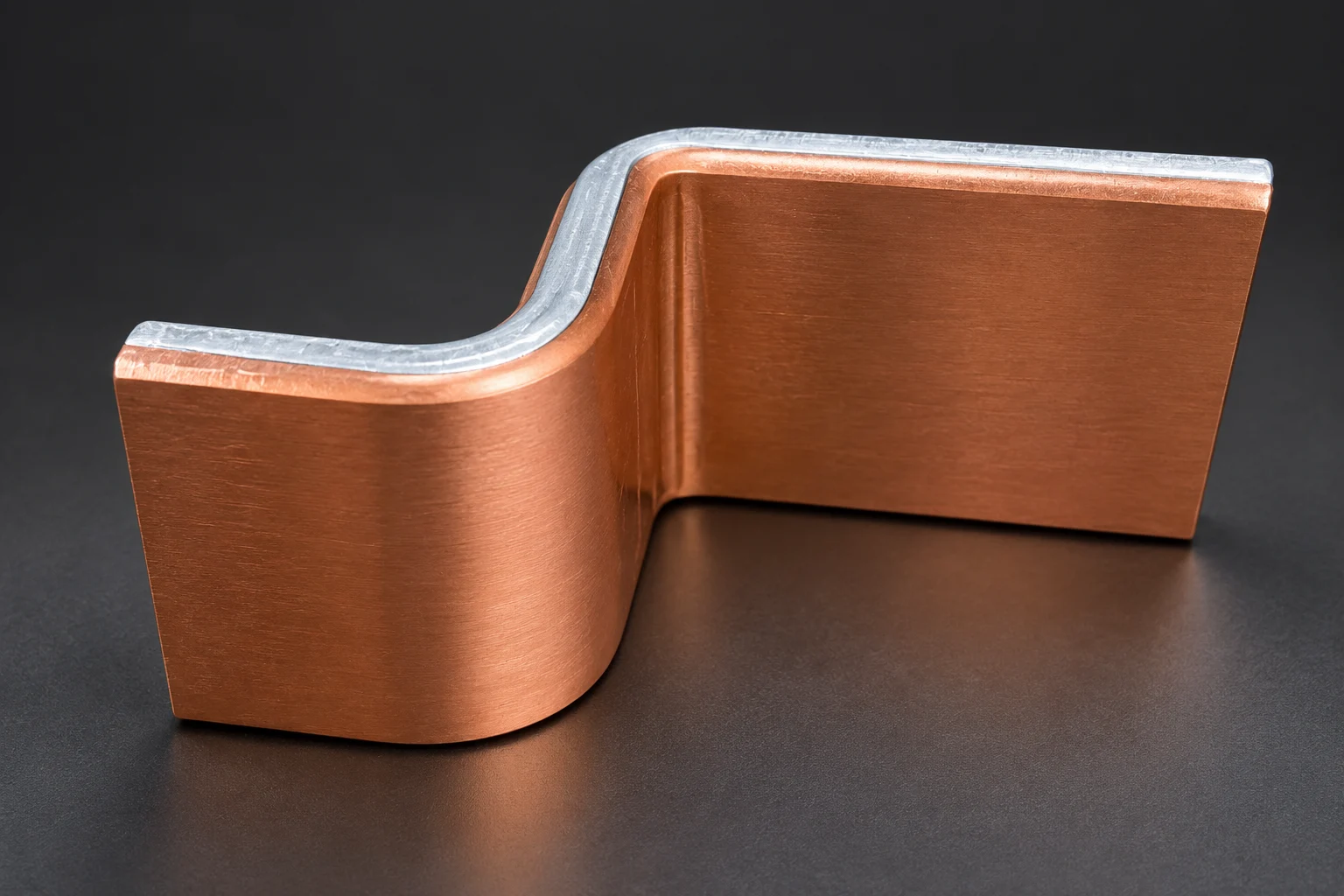
Accept a Cu-Al busbar cutting route against finished edges and dimensions after the agreed post-processing. Define layers, thickness and functional regions before comparing samples. The ability to cut copper or aluminum alone does not qualify a composite interface or its delivery requirements.
Separate the cutting principle from part qualification
TRUMPF describes conventional laser cutting through localized melting or vaporization. OMAX describes abrasive waterjet as a cold erosion process. These different edge-forming mechanisms cannot be compared from appearance alone.
Those descriptions do not supply qualified settings for the current Cu-Al construction. Ask for the actual route, fixturing and post-processing, using samples from the same material batch. Review changes in layer thickness, bonding route or stock thickness separately.
Assign edge requirements to drawing regions
Contact faces, insulation-covered edges and non-functional outlines may require different acceptance criteria. Mark section locations and record burr direction, local adherent material or erosion features, then inspect dimensions, straightness and copper-layer condition at the edge.
For thermal cutting, assess whether the nearby interface or affected region needs additional examination. Waterjet and mechanical routes still require geometry and particle/chip-removal review. Cold cutting does not replace composite-interface or finished-part inspection.
Compare the final delivery state
Include deburring, edge finishing and cleaning in the sample route. Retain the as-cut condition and subsequent results, rather than inspecting only the finished surface without knowing how much material was removed.
Where bending, plating or insulation follows, examine representative processed parts. Agree contact and insulation-edge acceptance for the project. Neither the equipment name nor a universal finishing rule establishes conformance.
Frequently asked questions
Does avoiding a conventional heat-affected zone guarantee a good composite part? The actual layers, edge, dimensions and post-processing still need checking.
Does a smooth edge remove the need for sections? Section inspection depends on function and risk; smooth appearance alone does not establish internal interface condition.
Machining RFQ inputs
Provide layer construction, thickness, profile and tolerances, marking contacts, insulation edges and downstream work. Request separate cutting, deburring, cleaning and inspection scopes. Qualify PCS busbar samples before comparing quotations for equivalent delivery states.
Apply this guide to a project
Use product pages to identify the hardware family and the calculator for early estimates only. Acceptance depends on drawings, operating conditions and project tests.