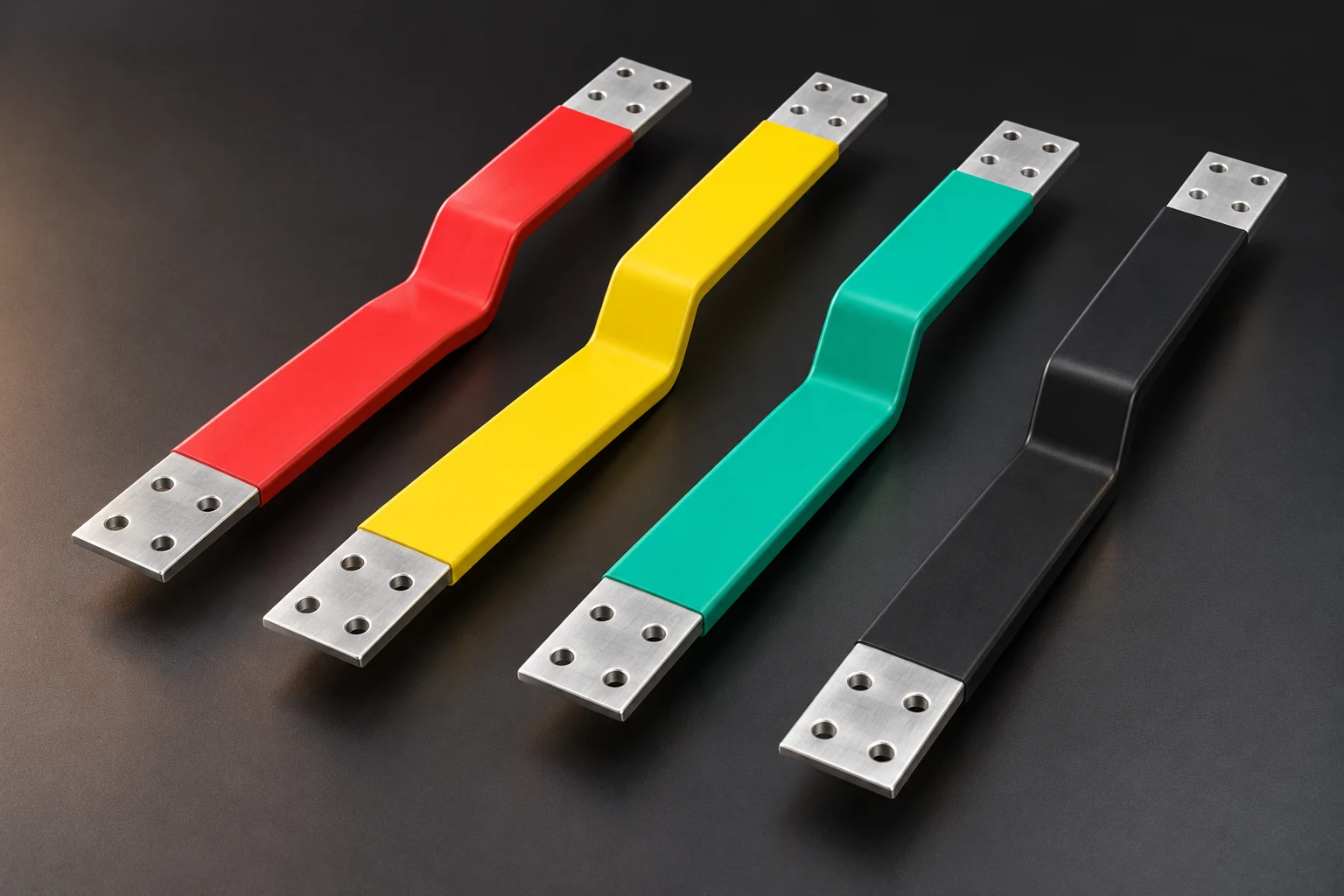
Agree the finished dry-film state, measurement method and locations before accepting a coated Cu-Al busbar. Wet film, uncured powder and cured readings are not interchangeable. An average does not establish every location's compliance with the drawing.
Match the drawing to the finished state
ISO 2808, 2019 edition, describes wet-film, dry-film and uncured-powder thickness methods as different measurement objects. Specify the coating system, measurement state, thickness requirements and tolerances in procurement documentation.
Where minimum and maximum limits apply, have the report address both. For multilayer coatings, distinguish total thickness from individual-layer requirements rather than splitting one total reading into assumed layer values.
Match the method to coating and substrate
ISO 2360, 2017 edition, principally covers amplitude-sensitive eddy-current measurement of nonconductive coatings on nonmagnetic conductive bases. Its scope does not automatically qualify the actual Cu-Al stack or make conductive metallic plating the same measurement object as insulation.
Provide the copper, aluminum, plating and insulation sequence to the testing party. Confirm instrument mode, reference specimens and adjustment. Review probe applicability near holes, cut edges and bends; agree another validation route where valid readings cannot be obtained.
Keep a location-based record
Propose a sample measurement map covering relevant planes, hole edges, bend faces and coating terminations. Retain individual readings and location photographs. Agree sampling and decision rules instead of allowing one average to hide drawing-critical thin regions.
Thickness, holidays, adhesion and dielectric checks address separate requirements. Retain each applicable result and recheck affected areas after rework. Thickness acceptance alone does not establish complete-part electrical insulation or long-term reliability.
Frequently asked questions
Does a passing average release the part? Local and extreme-value drawing limits and agreed sampling rules still apply.
Can one gauge directly measure both copper and epoxy layers? Confirm the measurement principle and stack, not only the displayed units.
ESS PCS insulated-busbar RFQ inputs
Supply the layer structure, insulation and masking drawing, dry-film limits and tolerances. List measurement mapping, method confirmation, sample records and assembly electrical checks separately. Resolve unsupported locations during qualification.
Apply this guide to a project
Use product pages to identify the hardware family and the calculator for early estimates only. Acceptance depends on drawings, operating conditions and project tests.